
Breakfast & Brunch
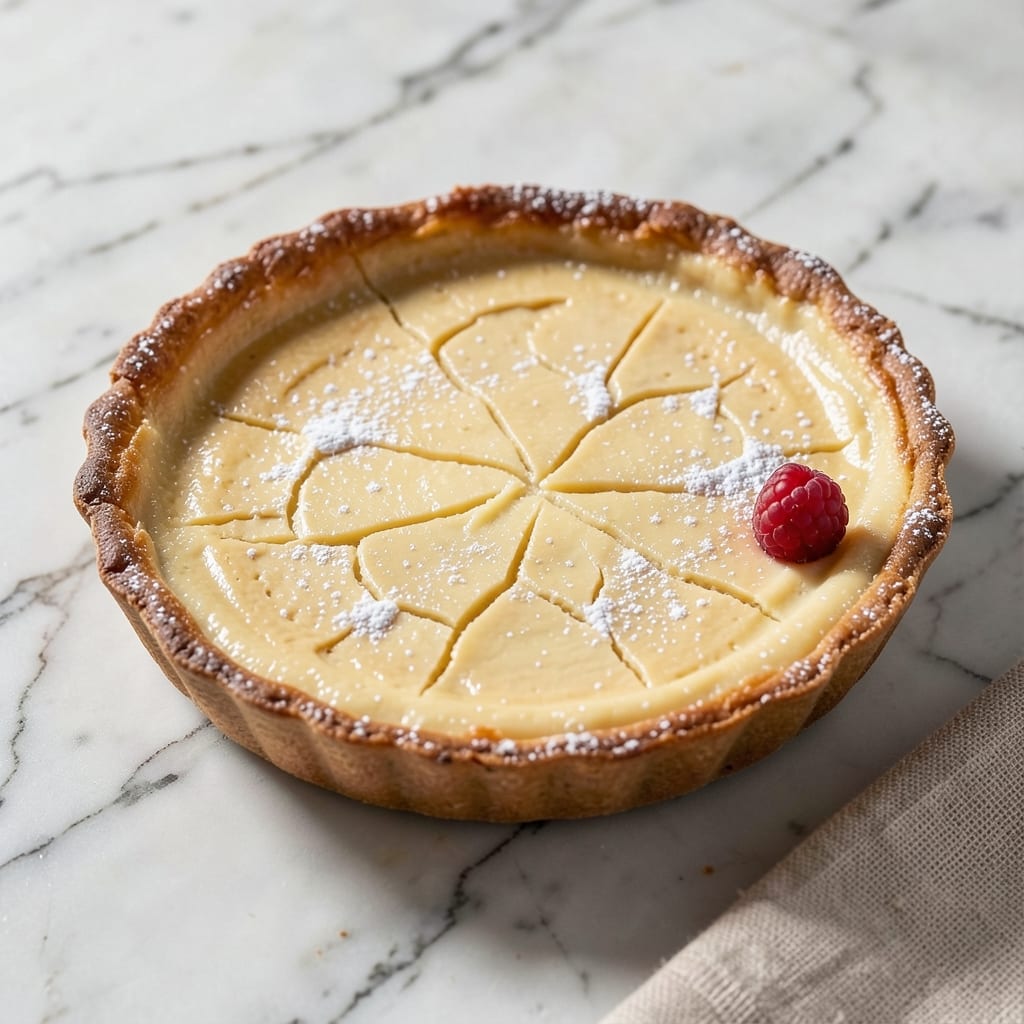
This baked egg custard tart recipe delivers the perfect balance of golden, flaky crust and silky egg custard with those signature marbled streaks. 💛 The secret lies in a crisp, buttery pastry that encases a rich custard filling—creamy yet firm enough to slice cleanly. I've perfected this technique over years of testing, ensuring every bite has that delicate contrast between tender custard and crisp edges.
The recipe begins with a classic shortcrust pastry that bakes to a beautiful golden brown while staying tender, not brittle. The custard filling is where the magic happens—a smooth blend of eggs, cream, and a touch of sugar that transforms into velvety perfection when baked. The key is precise timing in the oven to achieve those iconic egg streaks without overcooking.
What you'll end up with is a tart that's elegant enough for brunch but simple enough for any morning. The crust holds its shape beautifully, while the custard remains luscious and rich, with just enough firmness to slice neatly. Each bite offers that perfect harmony of textures and flavors—creamy, slightly sweet, and utterly satisfying.
These tarts are ideal for serving at breakfast gatherings, potlucks, or even as an impressive dessert option. The recipe scales easily, so you can make a single tart for two or a full tray for a crowd. Let's get started on creating these showstopping treats that will have everyone asking for seconds.
Ingredients for baked egg custard tart
Golden crust meets silky custard—just 11 ingredients for elegant morning tarts.
| Ingredient | Amount | Notes |
|---|---|---|
| All-Purpose Flour 🌾 | 2 cups | Sifted for light texture |
| Unsalted Butter 🧈 | 1 cup | Cold, cubed for pastry |
| Granulated Sugar 🍚 | ¼ cup | Fine grain preferred |
| Large Eggs 🥚 | 6 whole | Room temperature |
| Heavy Whipping Cream 🥛 | 1 ½ cups | Full-fat for richness |
| Granulated Sugar 🍚 | ¼ cup | For custard sweetness |
| Vanilla Extract 🌿 | 1 tbsp | Pure vanilla preferred |
| Salt 🧂 | ½ tsp | Fine sea salt |
| Ground Nutmeg 🌶️ | ¼ tsp | Freshly grated preferred |
| Almond Flour 🌰 | ¼ cup | For crust texture |
| Ice Water 💧 | ⅓ cup | Chilled for pastry |
The butter makes or breaks the crust. European-style unsalted butter (like Plugrá or Land O'Lakes) has higher fat content, giving you that perfect flakiness. Grab it cold from the fridge—never softened. For the almond flour, Bob's Red Mill is my go-to brand, but any finely ground almond flour works. The eggs should be at room temperature for a smooth custard—take them out 30 minutes before mixing. If your custard looks too thick, a splash of cream will save it.
No vanilla extract? Vanilla bean paste at half the amount works beautifully. Short on almond flour? Extra flour plus 1 tbsp cornstarch mimics the texture. The nutmeg is non-negotiable—it's what gives those classic custard tarts their signature warmth. If you can't find ground nutmeg, grate a whole nutmeg fresh (you'll need about 1/4 teaspoon). For the crust, if you're not using almond flour, add 1 tbsp cornstarch to prevent toughness. The ice water is crucial—never skip it—it keeps the dough from getting too warm.
Store the unbaked tart shells in the fridge for up to 2 days before baking. Once baked, they keep well at room temperature for 4 hours, but best served fresh. The custard filling can be prepped ahead and refrigerated for 1 day before pouring into shells. For make-ahead tarts, bake the shells, fill with custard, and refrigerate for up to 3 days—just reheat at 325°F for 10 minutes before serving.
Why You'll Love This Recipe
- No-Fuss Pastry: I swear by this crust—just flour, butter, and sugar rolled out in five minutes. No chilling, no fuss, and it stays crisp even when the custard gets soft.
- Creamy Luxe: That egg-cream combo? It’s like a cross between a custard and a fluffy cloud. The sugar caramelizes just enough to give it this subtle, buttery sweetness that keeps me coming back.
- Breakfast or Dessert: Honestly, I make these for both. Serve them warm with jam for breakfast or dusted with powdered sugar for an after-dinner treat. The same dough, two totally different vibes.
- Leftovers? Better: Between us, I always bake two. The custard thickens beautifully when reheated, and the crust stays fresh for days. Perfect for when I’m too tired to bake but still want something fancy.
Step-by-step instructions for baked egg custard tarts
Here's how to craft perfect golden crusts and silky custard that sets beautifully with marbled egg streaks.
👨🍳 Step 1: Prepare the Crust Dough
In a large bowl, combine the 2 cups all-purpose flour, 0.25 cup granulated sugar, 0.5 tsp salt, and 0.25 tsp ground nutmeg. Whisk until evenly distributed. Cut in the 1 cup cold cubed unsalted butter using a pastry cutter or your fingers until the mixture resembles coarse crumbs with pea-sized butter pieces.
Add the 0.25 cup almond flour and mix briefly to incorporate. Gradually pour in the 0.33 cup ice water while stirring with a fork until the dough just comes together. Avoid overmixing—just until the dough holds when pressed. Shape into a disk, wrap in plastic, and chill for 30 minutes to firm up.
🍳 Step 2: Roll and Bake the Crusts
Preheat your oven to 375°F. On a lightly floured surface, roll out the chilled dough to about ⅛-inch thickness. Cut into four equal rounds using a 4-inch round cutter and transfer to a parchment-lined baking sheet. Prick the bottoms with a fork and bake for 12-15 minutes until the edges are just beginning to turn golden.
Remove from oven and immediately press the bottoms with a fork to create a textured surface for better custard adhesion. Return to the oven for 3-4 more minutes until the crusts are fully set but still pale. Let cool slightly before filling—this prevents soggy bottoms.
🥘 Step 3: Make the Custard Filling
In a medium saucepan, combine the 6 whole large eggs, 1.5 cups heavy whipping cream, 0.25 cup granulated sugar, 1 tbsp vanilla extract, 0.5 tsp salt, and 0.25 tsp ground nutmeg. Whisk vigorously until the mixture is completely smooth and slightly thickened.
Place the saucepan over medium heat and cook, stirring constantly with a silicone spatula, until the mixture reaches 170°F and thickens enough to coat the back of the spoon. This should take about 5-7 minutes. The custard should be silky but not curdled—if it starts to bubble, remove from heat immediately.
🔥 Step 4: Fill and Bake to Perfection
Carefully pour the hot custard mixture into the cooled crusts, filling each about ¾ full. Place the baking sheet on a wire rack inside a larger roasting pan. Pour hot water into the pan until it reaches halfway up the sides of the baking sheet—this creates a water bath that ensures gentle, even cooking.
Bake at 325°F for 40-45 minutes until the custards are set but still slightly wobbly in the center. The edges should be golden brown, and you should see beautiful egg streaks forming through the custard. Remove from the water bath and let cool completely at room temperature before serving.
Pro Tips For Making Baked Egg Custard Tart
- Preheat to 350°F: DESCRIPTION:
- Whisk Eggs Like Mad: DESCRIPTION:
- Chill the Cream: DESCRIPTION:
- Blind-Bake the Crust: DESCRIPTION:
Essential equipment for this dish
Pastry Tools Must-Haves
Start with a 4-inch round cutter—I use the Wilton Non-Stick Silicone model for precision cuts. A pastry cutter (like Kitchenaid brand) is essential for blending butter into flour without overworking the dough. Don’t skip a rolling pin—I prefer the OXO Good Grips for even thickness control. A fork for pricking crusts and a bench scraper for clean dough edges complete my basic set. 💛
Precision Temperature Tools
An instant-read thermometer (like ThermoWorks Thermapen) ensures perfect custard temperature at 170°F. For baking, a digital oven thermometer (such as Thermoworks Smoke) verifies your oven’s accuracy—critical for even crust browning. I also recommend a wire cooling rack (like OXO Good Grips) to prevent soggy bottoms during custard cooling.
Mixing Essentials
Use a medium saucepan with sloped sides for smooth custard cooking—I love All-Clad Stainless Steel for even heat distribution. A silicone spatula (like OXO Good Grips) prevents custard from sticking while stirring. For dough mixing, a large mixing bowl (preferably Pyrex) keeps ingredients contained. A measuring cup set (like OXO Stainless Steel) ensures accurate ingredient ratios.
Baking Setup
Create a water bath using a large roasting pan and parchment-lined baking sheets (like Wilton Premium). A wire rack inside the roasting pan elevates the baking sheet for even heat circulation. For crust shaping, I use 4-inch tart molds (like Nordic Ware) if not cutting free-form. A pizza stone (optional) helps crisp the crust edges if preferred.
Cooling and Serving
Let tarts cool on a wire cooling rack (like OXO) to maintain crispness. For slicing, a sharp chef’s knife (like Wüsthof) ensures clean cuts. A damp towel helps prevent sticking when reheating. For presentation, I use small dessert plates (like Corelle) to highlight the golden crust and custard streaks. 🌟
Nutrition facts
Frequently asked questions
Can I make these egg custard tarts without a water bath?
While possible, a water bath is essential for perfect results. Without it, the custard may cook unevenly, risking a dry top or undercooked center. If you must skip it, bake at 300°F for 50-55 minutes and check frequently for doneness. The tarts will still be delicious but may lack the signature silky texture.
How do I prevent the custard from curdling?
Curdling happens when the custard overheats. Always cook over medium heat and stir constantly with a silicone spatula. Remove from heat immediately if it starts to bubble vigorously. For extra insurance, whisk 1 tablespoon cold cream into the custard before baking to stabilize it.
Can I use whole milk instead of heavy cream?
Not recommended for this recipe. Heavy cream provides the rich, velvety texture that makes these tarts special. If you must substitute, use 1 cup whole milk + 0.5 cup cream cheese blended into the custard for a similar mouthfeel. The flavor will be slightly lighter, but still delicious.
Why did my crust turn out greasy instead of flaky?
Greasy crusts usually mean the butter melted during mixing. Always keep butter cold and cut it into the flour quickly using a pastry cutter. Avoid overworking the dough—just mix until it forms a shaggy mass. Chill the dough thoroughly before rolling to prevent melting during baking.
How can I make these tarts ahead of time?
You can prep components separately for up to 3 days. Bake the crusts and store at room temp, then refrigerate filled tarts (unbaked) for 24 hours. For best results, bake from cold at 325°F for 50-55 minutes. Alternatively, bake completely and refrigerate for 4 hours—reheat at 300°F for 10 minutes before serving.